Caribbean Bareboat Charter Requirements: Do you need a Sailing License?
12 February 2026

- Is Skipper License required in the Caribbean?
- Is Formal Licensing Less Strict in the Caribbean?
- Why a Structured Sailing Resume Matters?
- What Charter Companies Evaluate Before Approving a Bareboat Charter
- 1. Total Logged Nautical Miles as Skipper
- 2. Recent Sailing Experience
- 3. Type and Size of Boats Sailed
- 4. Sailing Locations
- 5. Crew Experience
- 6. Practical Sailing Knowledge
- Important Exceptions: When a Sailing License May Still Be Required
- Final Recommendation
Is Skipper License required in the Caribbean?
Unlike the strict licensing requirements for bareboat charters in the Mediterranean, most Caribbean destinations do not require official sailing certificates, skipper licenses, or VHF certificates for recreational boat rentals. At first glance, this makes bareboat chartering in the Caribbean seem much easier — no exams, no mandatory courses, no paperwork.
However, a closer look reveals an important reality: you still need to prove your sailing competence, even if you already hold a valid sailing license issued by a recognized authority.
Is Formal Licensing Less Strict in the Caribbean?
In most cases, your sailing experience is verified remotely by the base manager — the person responsible for check-in and handover - based on the sailing resume you submit in advance. This initial review determines whether your bareboat charter can be confirmed.
However, even after remote approval, the base manager may still verify practical skills on site during the check-in procedure. This can include questions about maneuvers, anchoring, docking, or — if deemed necessary — a short checkout sail before final handover.
FAQ
-
Do you need a sailing license in the Caribbean?
Usually no, but experience verification is still required. -
Does having a license help?
Yes - it strengthens approval chances.
$423
per day
$438
per day
$1,516
per day

$556
per day
$367
per day
$896
per day

$679
per day
$1,677
per day
$179
per day
$457
per day
Why a Structured Sailing Resume Matters?
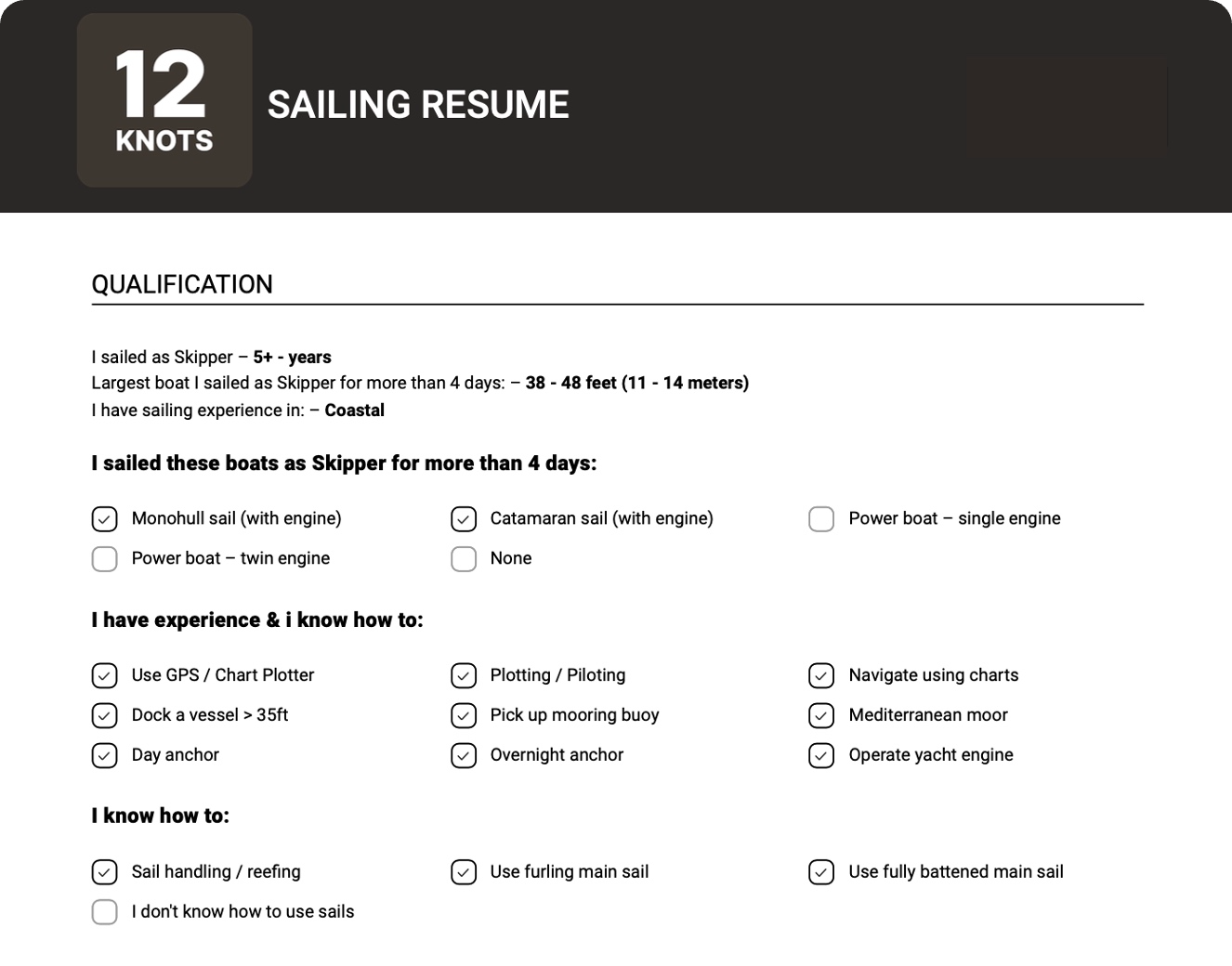
Since base managers often review multiple sailing resumes in a single day, a clear, concise, and well-structured sailing resume is essential.
To simplify this process, 12 Knots offers a structured online Sailing Resume that you can complete once in your personal account and reuse for future charters with any company. You only need to update it with your most recent sailing experience.
But what exactly are charter companies looking for before approving or rejecting a bareboat charter?
FAQ
-
What is a sailing resume?
A summary of your logged miles, boat types, and sailing locations. -
Can approval change at check-in?
Yes, if the base manager decides that practical skills need verification. -
Do I need to create a new resume for every charter?
No - you just need to update one in your personal account profile. -
Why is structure important?
It helps charter companies review experience faster.
What Charter Companies Evaluate Before Approving a Bareboat Charter
Charter companies assess several factors together rather than relying on a single metric.
1. Total Logged Nautical Miles as Skipper
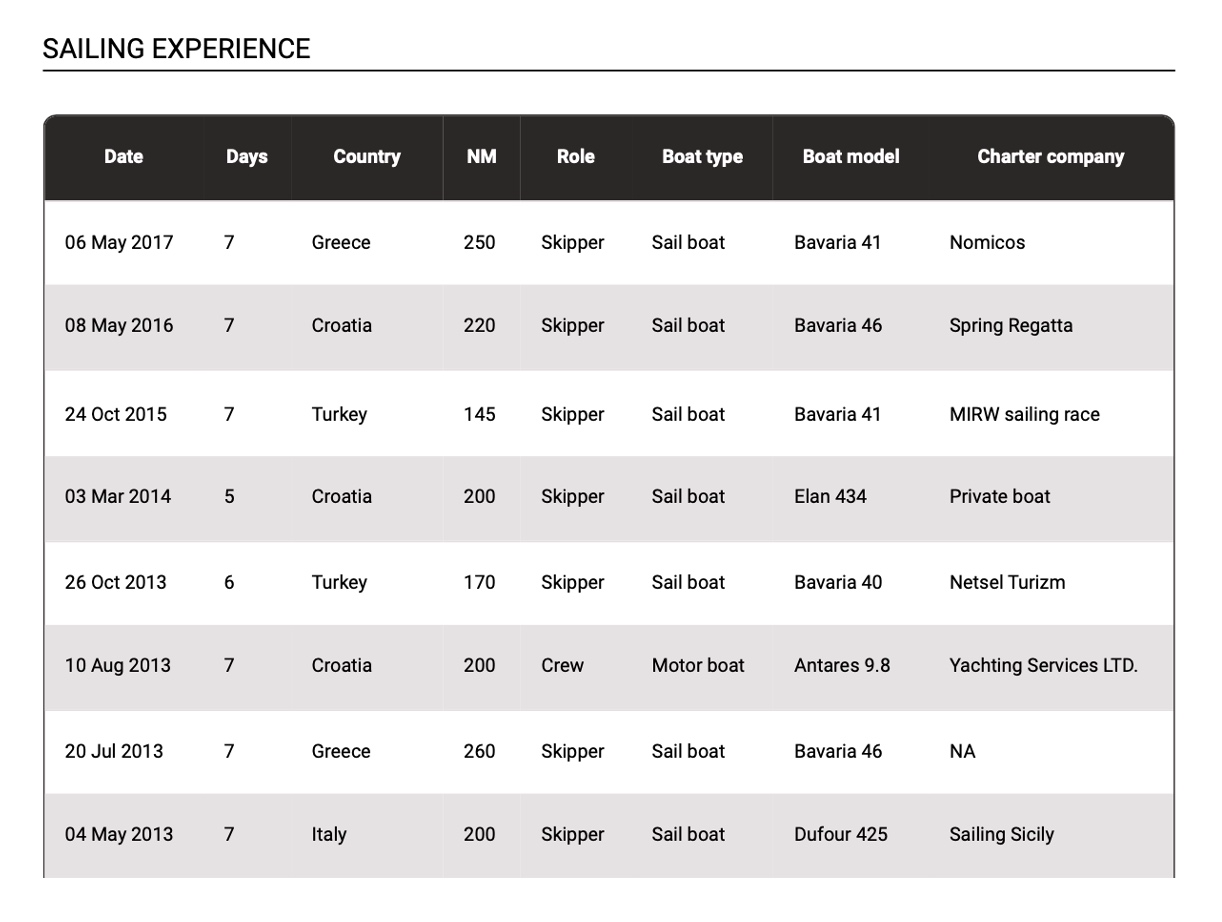
This is the first indicator of your overall experience. In most cases, 800 nautical miles or more logged as skipper is considered sufficient for approval. If you have less, approval may still be possible — but additional factors become critical.
2. Recent Sailing Experience
Experience from ten years ago carries little weight if you haven’t sailed recently. Charter companies typically focus on miles logged within the past 2–3 years, as sailing skills fade without regular practice.
3. Type and Size of Boats Sailed
Experience must be relevant. If you plan to charter a 50-foot catamaran but have only sailed 40-foot monohulls, approval is unlikely. On the other hand, extensive monohull experience combined with similar-size exposure may be acceptable when transitioning to a catamaran.
4. Sailing Locations
Not all sailing areas are equal in complexity:
- Beginner-friendly areas: BVI, USVI, Antigua (line-of-sight navigation, sheltered waters)
- Intermediate: Bahamas (shallow waters, tidal considerations, navigation by eye)
- Advanced: Windward Islands such as Martinique, St. Vincent, and Grenada (open-water passages, stronger winds)
This is why the location section of your sailing resume is crucial and must be filled out accurately.
5. Crew Experience
Single-handed sailing is usually not allowed. You must have at least one competent crew member — a first mate or deckhand — who can assist during maneuvers. This person should have basic sailing knowledge or prior experience.
6. Practical Sailing Knowledge
Base managers may ask general technical questions, such as:
- How many times have you anchored?
- Have you stayed overnight at anchor?
- Do you know how to tack and jibe?
- How comfortable are you with docking and mooring?
FAQ
-
How many miles are usually required?
There is no strict minimum. While around 800 nautical miles as skipper is commonly viewed as sufficient, charter companies evaluate the entire sailing resume, and sailors with fewer miles may still be approved. -
Does older experience count?
Yes, but recent sailing activity carries more weight.
Important Exceptions: When a Sailing License May Still Be Required
While most Caribbean authorities do not require formal sailing licenses, some charter companies — particularly in the Bahamas — may still require a valid sailing certificate as an internal policy.
Having a valid sailing certificate demonstrates theoretical knowledge and structured training, which can support the approval decision.
-
Are licenses ever mandatory?
Sometimes, depending on the charter company’s internal policy. -
Which areas may require stricter rules?
Certain fleets in the Bahamas.
Final Recommendation
If you are planning a bareboat charter in the Caribbean, we strongly recommend that you log in to your personal 12 Knots account, complete or update your Sailing Resume, and submit an inquiry for your chosen yacht.
This approach ensures a smooth approval process and avoids last-minute issues at check-in. Even though a sailing license is not always required, having one is always an advantage, as it demonstrates verified theoretical knowledge and practical training.